Marking AI text under the EU AI Act: what the law asks and how EPAV Desk does it
What Article 50(2) of the EU AI Act asks of AI systems that write text, when it applies, and how EPAV Desk marks the answers of its AI assistant with SynthID.
On this page
Since 2 August 2026, the EU AI Act asks companies whose AI systems write text to mark that text, so that a machine can tell it was written by AI. If a chatbot answers your customers, this concerns you. Here is what the law says, what it does not say, and how the AI assistant of EPAV Desk handles it.
What the law says
The rule is in Article 50(2) of the AI Act, Regulation (EU) 2024/1689:
"Providers of AI systems, including general-purpose AI systems, generating synthetic audio, image, video or text content, shall ensure that the outputs of the AI system are marked in a machine-readable format and detectable as artificially generated or manipulated."
Three things follow from it.
- Text counts. The rule is not only about fake photos and videos. A reply written by a chatbot is text content generated by an AI system.
- The mark is for machines. It has to be machine-readable and detectable. A visible "AI" badge does not meet this paragraph.
- As far as technically feasible. The same paragraph asks for solutions that are "effective, interoperable, robust and reliable as far as this is technically feasible", taking into account the limits of each type of content, the cost and the state of the art.
Telling people that they are talking to an AI is a different duty, in Article 50(1). A mark in the text does not replace it, and a notice in the chat does not replace the mark.
When it applies
- 2 August 2026. Article 50 applies from this date to every AI system on the EU market, whenever it was launched.
- 2 December 2026, for older systems only. The Digital Omnibus on AI, Regulation (EU) 2026/1744 published on 24 July 2026, gives providers whose generative systems were on the market before 2 August 2026 until 2 December 2026 to start marking. A system launched after 2 August 2026 has to mark from its first day. The Omnibus did not postpone the rest of Article 50.
The guidelines and the Code of Practice
Two documents explain how the Commission reads the rule.
- The Commission guidelines on the transparency obligations of Article 50, C(2026) 7702 final of 5 November 2026 (Commission page). They are not binding, only the Court of Justice gives the final reading of the law, but supervisors are expected to work from them.
- The Code of Practice on Transparency of AI-generated Content, final text of 10 June 2026 (Commission page). Signing it is voluntary. The Commission and the AI Board found it adequate in July 2026.
For a chatbot, three points of the Code matter most:
- Text in a chat or on a web page carries no metadata, so one layer is enough for it: an invisible watermark in the text itself.
- Texts shorter than 200 tokens count as very short and do not need a mark.
- Checking the watermark of free text may be limited to vetted experts such as regulators, journalists and researchers, so that unlimited checks do not help someone learn how to strip the mark.
Who is responsible
The guidelines name two roles. A company that offers an AI system under its own name to other businesses is its provider. A business that uses the system in its own work is its deployer.
For the AI assistant of EPAV Desk, EPAV is the provider and your store is the deployer. Marking under Article 50(2) is the provider's duty, so it is ours.
The guidelines also allow a provider to rely on the mark that the maker of the underlying model already puts into the text, while the provider still has to show that the system as a whole complies. This matters for the cloud AI of our plans, see below.
Fines for breaking Article 50 go up to EUR 15 million or 3% of worldwide annual turnover. For small and medium companies, including start-ups, the lower of the two applies (Article 99 of the AI Act).
What SynthID is
SynthID Text is a watermark for text, made by Google DeepMind and published as open source (SynthID on Google AI for Developers, code on GitHub).
When a language model writes, it picks each next word from many good candidates. SynthID nudges that choice slightly towards words that score high under a secret key and the few words before. One nudge means nothing, but over a long text they add up to a statistical pattern. A checker that knows the key can measure the pattern. A reader sees an ordinary text.
It has honest limits:
- a short text has too few words for the pattern to show, which is why the Code of Practice does not ask to mark very short texts;
- heavy rewording and translation into another language weaken the pattern;
- the check gives a probability, not a proof, and it can only find a mark made with its own key.
How EPAV Desk marks the answers
The answers of your assistant can be written by different models. Each one is marked by whoever runs it.
| Who writes the answer | Who marks it | Who can check the mark |
|---|---|---|
| Our free model, which answers on the trial and when the cloud AI of your plan runs out | EPAV, with SynthID, in every answer | EPAV, with a check key |
| Our translator, when it translates a text longer than 200 tokens | EPAV, with SynthID | EPAV, with a check key |
| The cloud AI of your plan: Claude, a model by Anthropic | Anthropic, with its own invisible mark | Anthropic, on request |
| Your own AI provider or your own model, if you connect one | You choose a provider that marks | Depends on the provider |
| A model on your own hardware that we install for you | As we agree with you | As we agree with you |
Our own models. Our free model puts the SynthID mark into every answer it writes. Our translator marks the texts longer than 200 tokens it translates; shorter translations are left as they were. A check needs more than 200 tokens to find the mark, so most short support replies carry no mark that can be detected, which is what the Code of Practice expects for very short texts.
The cloud AI of your plan. After payment, the answers come first from Claude by Anthropic, which we reach on Google Cloud and AWS in the EU. Anthropic has signed the Code of Practice, and its models put an invisible mark into the text they write, also when they run at cloud partners such as AWS and Google Cloud. We rely on that mark, as the guidelines allow. Anthropic checks it: detection is in private preview for regulators, media, researchers and other eligible organisations. See How Claude marks AI-generated content.
Your own provider. You can connect your own AI provider with your own key, or your own model. It then writes the answers instead of our models, and the mark of those answers is your responsibility, as our Terms of Service say in Sections 12.4 and 12.8. Before you connect one, ask the provider two questions: do your models put a machine-readable mark into the text, and who can check it?
How to check a text
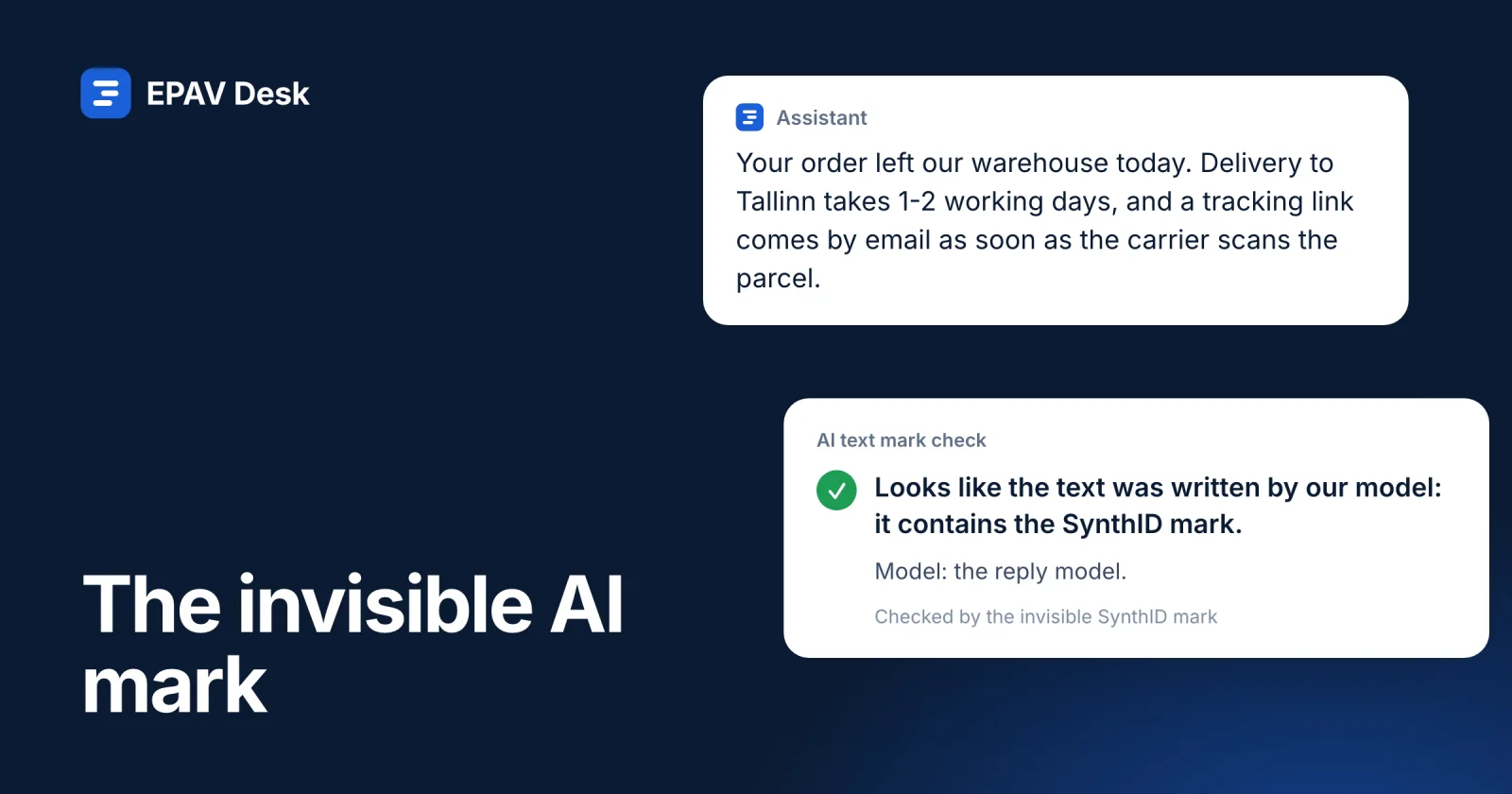
Paste the text on https://my.epavdesk.com/check together with a check key and press Check. You get one of three answers: the text carries the mark of our models, it does not, or it is too short to check.
- Signed result. You can download the result as a file signed by EPAV (Ed25519). The file holds the fingerprint of the text (SHA-256), not the text itself, so you can pass it on as proof of the result.
- The text is not kept. The text you check is used only for the check and is not stored or written to logs.
- Check key. On the Ultra plan, the key is in your cabinet. On the other plans, you request it from the cabinet and we reply by email.
- No account. Regulators, journalists and researchers without an EPAV account write to support@epavdesk.com.
- API. The same check works through an API, described in our documentation: AI mark and check.
Our check finds only the mark of our own models. Answers written by Claude carry Anthropic's mark, and Anthropic checks those.
What this means for your store
- With our models and the cloud AI of your plan, the answers are marked by us or by Anthropic. You do not need to set anything up.
- With your own provider or model, the mark is up to you. Choose a provider that marks AI text.
- Telling visitors that they are talking to an AI is a separate duty under Article 50(1). Make sure your chat says it, for example in the assistant's first message.
Marking does not change what your customers read. It lets a regulator, a journalist or you yourself find out later that a long text was written by AI, which is what the law asks for.